
Cover of The Push-and-Pull Adventure
Story languageEnglishEspañol
Physical ScienceForce, Types of Forces, and Effects of Force

The Push-and-Pull Adventure

By Vaishnavi Renduchintala · Ages 8-15 PDF Book Free

No reviews yet — be the first!

At Wonder Pier, Maya and Ethan help inventor Mr. Oliver move a heavy parade cart—and discover that a force is a push or a pull with both strength and direction. Through carnival demos, they explore contact forces like muscular force and friction, then invisible forces at a distance: magnetic, gravitational, and electrostatic.

People who read this book also read

Cover of The Race Around the Park: Speed and Velocity
Physical ScienceSpeed & Velocity

The Race Around the Park: Speed and Velocity

On a Saturday morning at the park, Emma and Noah race to the big oak tree—then Dad turns their fun into a physics lesson. With stopwatches, lake loops, and cyclists on the path, they discover how speed, velocity, distance, and displacement are different—and why direction matters.

By Vaishnavi Renduchintala · Ages 8-15

FreePDFNo reviewsView More
Cover of The Energy That Made Everything Happen
Physical ScienceForms of energy & energy transformation

The Energy That Made Everything Happen

When a flashlight flickers, a ball rolls, and a bell rings, two curious kids trace the energy that made everything happen—discovering how stored energy transforms and moves from one object to another.

By Vaishnavi Renduchintala · Ages 8-15

FreePDFNo reviewsView More
Cover of The Backpack That Felt Lighter
Physical ScienceMass vs. Weight

The Backpack That Felt Lighter

When hauling a stuffed backpack up a steep hill feels impossible, two curious kids discover tricks that make the backpack that felt lighter—learning how ramps, wheels, and spreading force over distance can make heavy loads easier to move.

By Vaishnavi Renduchintala · Ages 8-15

FreePDFNo reviewsView More

🔬 Science Element

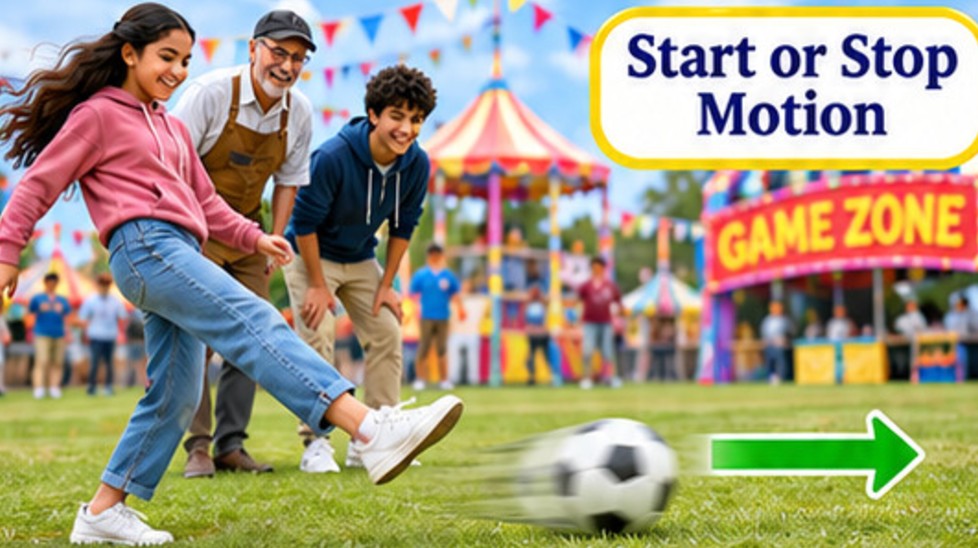
A force is a push or a pull and is a vector quantity because it has magnitude (strength) and direction. Contact forces need physical contact (examples: muscular force and friction). Forces at a distance act without touching (examples: magnetic, gravitational, and electrostatic forces). Forces can start, stop, speed up, slow down, or change the direction of motion, and balanced forces cancel while unbalanced forces change motion.

Rate this story

Your rating (required)

Reader reviews

No written reviews yet.